Showing posts with label Crafts. Show all posts

Friday, February 20, 2015

A Use for Scotch Broom

The stuff in the bucket is the scotch broom plant material after being cooked for dye, and the yarn above is the finished product.

Those of you who live close by know that we are slowly reclaiming our property from scotch broom (Cytisus scoparius), an invasive plant that inhabits the west. When we bought our 50 acres, maybe 20 of them were covered in various-aged stands of this woody perennial. It can be anywhere from 3-15 feet tall, and each individual plant produces maybe tens of thousands of beautiful, brilliant yellow blossoms during it's season in April-June. Each flower produces approximately 10 seeds that eject from their pea-shaped seed pods once they dry out at the end of the bloom. In June and July, when the bulk of them explode, it can sound like a fire is crackling in the stand near our house.

Although we are working each year to decrease the prevalence of this noxious plant, I have found a verifiable use for it: dye! Scotch broom is closely related to French broom, also called Dyer's broom (Genista tinctoria). I suspected I could get a dye, using the same instructions, and found that YES! I can! I collect branches during the height of the bloom and strip the blossoms off, and then dry them, and I can use them to create a pale, slightly green, yellow color for my yarn. Now that's local!

Yarn in front is first dyebath, yarn in back is second dye bath.

Sunday, May 8, 2011

Hand Knitted Socks


Adult socks knitted in Panda Soy "Stained Glass", 2-at-a-time


Children's Socks, Knitted in MochiPlus, 2-at-a-time

Oh dear, it's been a while since I've posted. Pregnancy hasn't been so kind to me, diminishing my immune system and leaving me vulnerable to every passing virus. I've been sick a lot over the last two months...

But. Some backlog posts. I wanted to show off my knitted socks. The red pair are mine, and the first pair I've knitted with the two socks at the same time with the two circular needles method. They are knitted with a yarn called PandaSoy, which is made with bamboo and soy fiber.

The pink pair are the second attempt at the two-at-a-time socks, and my first attempt at using something other than a very basic sock pattern. It has a ribbing pattern only on the top of the foot. These I knitted as a gift for my daughter, who was requesting "pink, fluffy socks". I used the MochiPlus yarn, a beautiful, soft, painted yarn that does really cool color changes. I made them a little large, so she could wear them next winter, since it's almost summer (though the weather lately wouldn't necessarily suggest that).

I am currently working on a few knitted projects, but my enthusiasm for knitting has kind of faded with sunnier outdoor skies. As it should be. I am wanting to knit while I can, knowing I won't be able to so much once our new baby arrives this July.

Friday, January 7, 2011

Baby Sweaters


For some reason, I haven't really mentioned anything about my knitting obsession on this blog before, but it went into high gear last fall, when I helped host a knitting workshop for beginners and intermediates. I've been knitting since I was about 9 or 10 years old, but I've only begun attempting actual projects in the last 6 years or so.

These last two years or so, I've started knitting baby sweaters for all the cuties being born around these parts. This one above I love, it's so warm AND has a hood. Essential for Mattole babies.

I've also been knitting socks, hats, scarves, fingerless gloves, and I even tried a pair of mittens. I don't know why, but following instructions to create something just lights me up. Weird. I know. But fun.

I'm so excited about it that I've started contemplating raising my own fiber animals so I can raise some of my own yarn. We have a great local fiber artist who knows a lot about it. We've discussed what it might look like to get a local fiber cooperative going, and to create a micro brand of yarn. A fun pastime, contemplating what's possible, and how delightful it would be to knit with locally-raised Mattole yarn.

Saturday, April 11, 2009

Easter Preparation at the Homestead


Purple Cabbage, Water, and Vinegar, for Making Blue Dye


Putting Onion Skins Around the Egg


Wrapping the Egg


Tying the Cloth Wrapper


Unwrapping the Onion-Skin Dyed Egg


Onion-Skin, and Onion-Skin-Nettle Dyed Eggs


The Whole Dozen (Minus Two for Snacks) All Made With Natural Dye


A Delighted Ella

What a perfect follow up to my post about chickens!

Easter in Petrolia is kind of an institution. There is an egg hunt for the kids every year, at a neighbors house. We bustle about and make our eggs for delivery the day before, and a crew of diligent and creative people hide them the morning of the hunt, in the crooks of trees, next to rocks, along fences and porches, and inside random pieces of rural trash (i.e. dead cars). After the hunt, the older kids participate in a scavenger hunt, at the end of which is an easter basket for each child, complete with a stuffed animal and some candy. Ella sort of got it last year, but THIS year, well, she is really excited for tomorrow. All day, she has been begging me to go to the hunt. I tell her it's not happening until tomorrow, and she then asks, "But WHYYYYY, momma?"

This morning, we dyed our eggs. I sent Drew for supplies last week, and he balked at buying those silly little commercial kits. He came home instead with beet powder, and suggestions of using turmeric for yellow dye. Hmmm. Not what I was thinking, but I began researching online, and found several recipes for natural dye using such materials. So this morning after breakfast, we started cooking up homemade dye. Water, beet powder (available at our natural food store, who knew?!), and vinegar for red; Water, turmeric, and vinegar for yellow; water, red cabbage, and vinegar for blue. I boiled each of the concoctions for a while, and then strained the turmeric potion (through a coffee filter), and the cabbage, through a strainer. And we did a few in Drew's mom's traditional way, using yellow onion skins held on tight to the egg with a piece of fabric. You just hard-boil them in that little cloth package. We laid a stinging nettle leaf on one of those, and wow, did it come out a beautiful, natural shade of green.

If you are interested in exploring these websites and recipes yourself, check out these two: one with lots of natural dye recipes for various colors, and another for making Chinese "Tea Eggs", where you crack the outer shell of the hard-boiled egg before you dye it, leaving the shell-crack impression on the finished egg. They look like china ware in psychedelic colors, so cool.
Who knew natural eggs could come out so beautifully? Who needs Paz? Not ME, anymore!

Sunday, March 15, 2009

Petrolia Foxfire: Spinning Workshop

I am a knitter. It's an obsessive sort of hobby, and being a student of sustainability, my thoughts sometimes turn to sheep, as a means to make yarn. I've also long fantasized about learning the art of spinning, and this weekend, I was given the opportunity. Our friend Michael is a fiber artist (as well as a very skilled woodworker). He learned his craft from his grandmother, who recently died, and left him all of her materials, tools, hardware, and the like. Last year, he drove a U-Haul back from some far off place, Florida I think, full of a weavers dream: wool, yarn, looms, spinning wheels, books, woven pieces, and the like. Since he returned with all that stuff, he has been excited to share the skill of spinning and weaving with our community.

Through a grant from the Humboldt Area Foundation, about 15 of us were able to take this two-day workshop free! Snacks and childcare were provided, and Michael hand made each of us our very own hardwood drop spindle. What a fabulous way to spend a weekend.

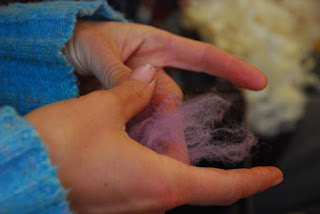
First, we learned how to take the raw, washed wool, and separate out the fibers, and orient the strands all the same way. After meticulously making a downy pile of this material, we seated it on the cards, and carded it until it was straight and combed. Then, we rolled it off the cards, creating a fluffy tube. Many of us commented on how tedious this task was, but when no one was complaining about that, we had delightful conversations about all manner of things sheep, wool, and yarn. It was something like a knitting circle, a cultural phenomenon that must have been a staple of community relationships in times past.


Raw Washed Wool Ready for Carding


Separating and Orienting the Fibers


Seating the Fibers on the Cards


Carding the Wool

After we collected a pile of the fluffy tubes, we each chose our spindle, and Michael at last demonstrated the proper technique for spinning a yarn with the drop spindle. Using a little tail of already spun yarn, you wrap it around the "bobbin" at the bottom of the spindle, and then loop it around the top. Then you can spin the spindle clockwise, and pinch, draft, let go, allow to twist, pinch, and so on, and out stretches your first attempt at yarn, lumpy, uneven, but so very satisfying. After about 5 feet of length, you must untie the part on the spindle, wind up your newly made yarn, and repeat.


Spindles


Fluffy Tubes of Carded Wool Ready for Spinning


Setting Up the Spindles for Spinning
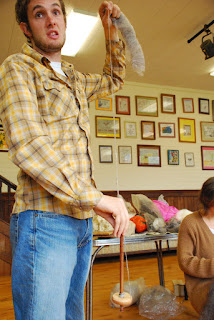

Michael Demonstrating Spinning Technique

Michael sent us home overnight with raw wool, cards, and of course, our new spindles. I practiced a little, and by mid-way through this morning's session, I was getting a little faster at it. What fun! At this point, Michael demonstrated the use of the spinning wheels, which I was very excited to try, but found a lot harder to master even basic technique. It requires a bit of coordination, between your feet which are operating the wheel, and your hands, which are doing the pinch, draft, release, pinch repetition, all the while maintaining the proper tension to allow the resulting yarn to wind on a spool. I can see that this task will require at least a bit more practice.


Michael Demonstrates Use of the Spinning Wheel


Jane Gives it a Try

It's a little disconcerting to feel so helpless at a task that was very common and required all but maybe 100 years ago, give or take a few years. What was so exciting was the buzz amongst the community of new spinners, our desire to learn the craft, and to figure out the local supply chain. Plans were made for regular spinning gatherings, and also for a dyeing workshop. I think that we are all a little needy of the community craft culture, the conversations and group thinking that happens when people gather around a task that occupies the hands, but keeps the mind free to wander. I imagine this is where the expression "spinning a yarn" comes from, the stories people would tell while spinning fiber to clothe their bodies.